DF/ai Editor
            Status:      Experimental
            Period:      2026
            Technology:  Tauri 2, Rust, Solid.js, TypeScript, Vite, AI APIs
            Source Code: GitHub
Introduction
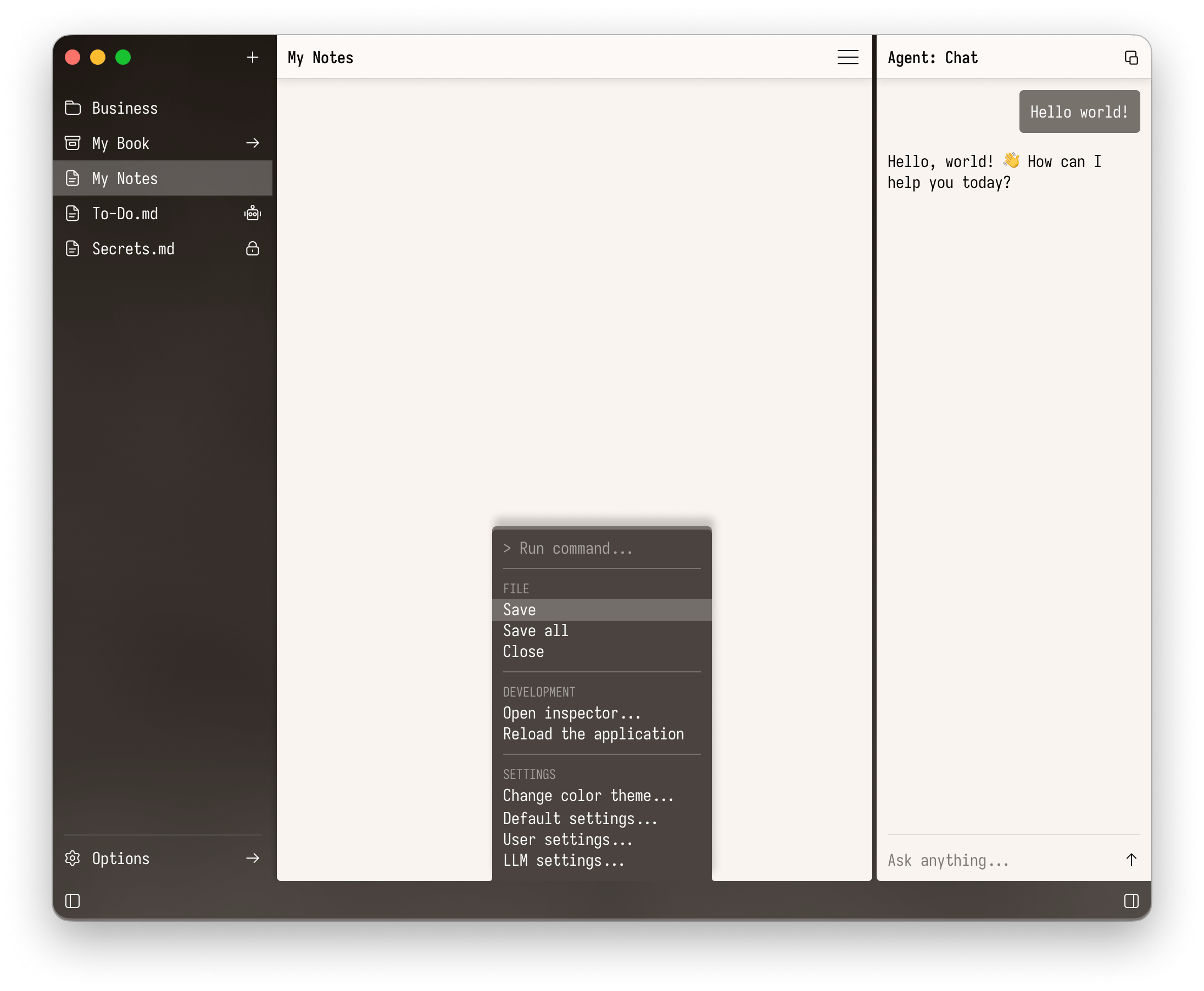
DF/AI Editor is an experimental desktop workspace exploring how humans and AI might collaborate on local documents in a secure, extensible environment.
Rather than building another markdown editor or another AI chat application, the project explores new interaction models between documents, programmable workspaces, and language models.
It is intentionally opinionated, highly experimental, and willing to challenge conventional desktop application design.
Design Philosophy
This project is an experiment.
Architecturally, visually, and technically.
The interface intentionally avoids the polished familiarity of modern productivity software in favor of a distinctive identity built around monospaced typography, pixel-inspired aesthetics, command palettes, configurable themes, and minimal visual distractions.
The goal is to explore what a programmable desktop workspace could become when AI is treated as another participant rather than the primary interface.
AI as Context
The central idea behind DF/AI Editor is attaching AI to context rather than just opening chat window.
Instead of asking users to repeatedly copy information into prompts, the workspace defines explicit context.
An AI can be attached to:
- a single document
- a folder
- an entire workspace
- eventually any other supported surface
Each AI instance operates inside carefully defined boundaries.
It receives only the context it has been granted together with its own instructions, creating specialized assistants rather than one general-purpose chatbot.
This makes AI interactions more predictable, reusable, and easier to reason about.
AI Providers
One of the goals of DF/AI Editor is to explore AI independently of any single provider.
The editor is designed around a provider abstraction, allowing the same workflows to operate with different language models depending on the user’s needs.
Currently supported providers include:
- Bundled — lightweight local models distributed with the application for fast, offline-capable tasks.
- Ollama — locally hosted open-source models running entirely on the user’s machine.
- OpenAI-Compatible APIs — any provider exposing an OpenAI-compatible interface, including OpenAI, Gemini compatibility layers, LM Studio, vLLM, and self-hosted services.
Supporting multiple providers has also been an opportunity to better understand the practical strengths and limitations of local versus cloud-based language models. Some workflows benefit from the privacy, speed, and offline capabilities of local inference, while others require the reasoning ability and larger context windows available through hosted models.
The long-term goal is to make AI a flexible capability of the workspace rather than a dependency on any particular vendor.
Small Core, Plus Plugins
Another major design goal is keeping the core application intentionally small.
The editor itself should know as little as possible.
Instead, functionality is expected to emerge through plugins.
The core is responsible for:
- security
- permissions
- filesystem access
- application lifecycle
- communication infrastructure
Everything else must evolve independently through user-editable plugins.
This keeps the application flexible without allowing the core architecture to become increasingly complex over time.
Local First
The project is built around local files.
Documents remain ordinary files stored in open formats that users fully control.
There are no opaque databases or proprietary storage formats standing between the user and their data.
This philosophy extends beyond storage.
Security, encryption, permissions, and clear boundaries are treated as first-class architectural concerns.
Experimental User Experience
DF/AI Editor intentionally embraces personality.
The interface explores:
- pixel-inspired visual language
- monospaced typography
- command palette workflows
- configurable themes
- lightweight panels
- context-aware interactions
Every design decision becomes an opportunity to question assumptions about how desktop productivity software should look and behave.
Current Direction
The project continues to evolve around a single question:
What does a desktop workspace designed for AI collaboration actually look like?
Rather than adding isolated AI features, the goal is to rethink the relationship between users, documents, programmable tools, and language models from the ground up.
Whether the current ideas ultimately succeed or fail is less important than exploring the design space thoughtfully and learning from the process.
Reflection
DF/AI Editor is perhaps the most experimental project in my portfolio.
It combines many interests that have appeared throughout my previous work: modular architecture, extensibility, product design, local-first software, and thoughtful user experience, while exploring how AI changes the way we interact with our own information.
More than a text editor, it is an ongoing exploration of what the next generation of desktop software might become.